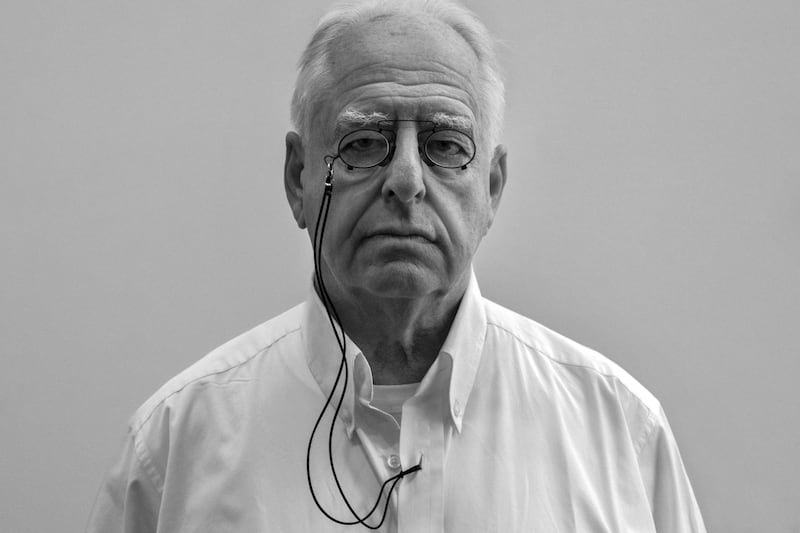
A black cat becomes a typewriter, a cash register, a tree. Buildings collapse, their broken outlines sprouting branches. A few strokes of charcoal become a figure, a street, an entire city. In William Kentridge’s world, almost anything can turn into something else.
There is something instantly recognisable about his work: the expressive, smudged black-and-white drawings, the movement, the music, the theatricality. Encountered in museums, galleries and opera houses across the world, it carries an unmistakable identity. His work spans drawing, film, sculpture, opera and theatre, often on an enormous scale, yet the handmade character of his work remains central to everything he creates.
At Goodman Gallery on London’s Cork Street, the 2026 exhibition A Nicely Built City marked the world premiere of A Nicely Built City (Never Resists Destruction), a nine-minute film and the twelfth in his celebrated Drawings for Projection series, begun in 1989.

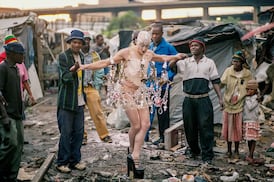
Johannesburg, where Kentridge was born in 1955 and continues to live, has been a recurring subject throughout the series. Built on gold, ambition and enormous wealth, but also exploitation and inequality, the city has provided him with material for nearly four decades. Growing up under apartheid, the son of two prominent anti-apartheid lawyers, Kentridge developed an early awareness of political injustice that continues to inform his work.
The film’s title comes from a West African proverb: “a nicely built city never resists destruction”. Its starting points include the aftermath of the 2023 gas explosion beneath Johannesburg’s Lilian Ngoyi Street, formerly Bree Street. Images of damaged buildings from Gaza, Caracas, Tehran and Tel Aviv also enter the film, their fractured structures transforming into trees.
The imagery is unsettling, yet there is humour, absurdity and an irresistible sense of play, particularly in the wonderfully unpredictable black cat that wanders through the film.

“The cat is an animal uniquely suited to animation,” Kentridge explained in an interview with art critic Paul Carey-Kent. Almost any curved charcoal line, surrounded by a smudge, can become one. More than a visual joke, the cat is a protagonist in its own right, appearing ahead of the explosion and transforming continually as the story unfolds.
The cat belongs to Soho Eckstein, Kentridge’s pinstriped industrialist, who first appeared alongside Felix Teitelbaum, an artist and dreamer, in Johannesburg, 2nd Greatest City After Paris in 1989. The two characters, representing contrasting worlds, have accompanied Kentridge through decades of South African history.
Originally a symbol of capitalist power in apartheid-era South Africa, Soho has barely aged in the intervening decades. Kentridge, meanwhile, is now 71. The artist has spoken about how he has gradually grown closer in age to a character he once regarded as an older antagonist.

Soho’s world is filled with rotary telephones, typewriters and mechanical adding machines, objects Kentridge favours because their workings are visible. That fascination with how things work extends to his animation.
The principle is deceptively simple. He makes a charcoal drawing, photographs it, rubs away sections, redraws and photographs it again. Thousands of small alterations gradually become a moving film, while faint traces of previous images remain on the paper.

The London exhibition, which closed on November 7, brought together around 50 original drawings used to create the animation, revealing the physical process behind the moving images. In places, the repeated movements of figures and objects remain visible as faint marks across the paper.
Music is integral to the film. Philip Miller’s score moves from the urgency of Johannesburg’s streets, where South African singer Sun Glen Chabalala is heard against driving percussion, to the restraint of a piano inside Soho’s modernist house. The contrast is not simply atmospheric: the score makes the distance between the city’s public turmoil and Soho’s sheltered private world audible.

As Kentridge explained to Annabel Downes in Plaster, bringing sound and image together is a process of discovery, rather than something worked out in advance. Music is not simply added to illustrate the drawings; it becomes part of how their transformations unfold.
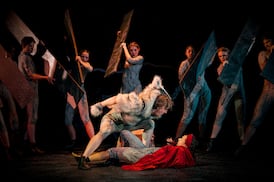
The London exhibition also explored another dimension of Kentridge’s imagination, bringing together works connected to his 2026 Glyndebourne production of Monteverdi’s L’Orfeo, based on the ancient Greek myth of Orpheus and Eurydice.

These included drawings, sculptural figures developed with Belgian costume designer Greta Goiris, and Orpheus, Eurydice, and Hermes;, an installation using Pepper’s Ghost, a nineteenth-century theatrical illusion in which reflections in glass make figures appear and disappear.
The effect is haunting. Figures materialise from darkness, move and vanish, suspended somewhere between sculpture, film and performance. It offers a glimpse of the ambition of Kentridge’s theatrical productions, where music, puppetry, projected drawings, performers and elaborate stagecraft come together through the work of numerous collaborators.
For those who missed the London exhibition, Athens offers another encounter with Kentridge’s work. At the National Archaeological Museum, Imitate the Sleep of Stones runs until January 24 2027, bringing his contemporary drawings, sculptural figures and paper trees into dialogue with ancient Greek artefacts associated with music, death and transformation.

The Orpheus, Eurydice, Hermes installation seen in London also appears here. The exhibition coincides with the Greek National Opera’s staging of his L’Orfeo, bringing the myth back to the city where its cultural roots run deepest.
There is a connection between these worlds. Orpheus descends into the underworld in an attempt to recover his lost Eurydice. Kentridge repeatedly returns to Johannesburg, reconstructing a city transformed by history through drawings that retain traces of what has disappeared.
For all the sophistication and scale of his productions, Kentridge continues to find possibilities in the simplest materials. There is a revealing story about the development of his charcoal animation.

When he first began making the films, he was frustrated by his inability to erase the drawings completely. He experimented with different papers and erasers, searching for a cleaner image, and even promised friends that he would improve the technique.
Eventually, someone pointed out that the imperfect erasures he had been trying to eliminate were actually one of the most interesting things about the work.
Nearly four decades later, those stubborn smudges have become inseparable from his art. In a film about a city where so much has been demolished, altered or forgotten, it seems particularly fitting that the past refuses to disappear from the paper.
Exhibition information
William Kentridge: Imitate the Sleep of Stones
- Venue: National Archaeological Museum, Athens
- Dates: October 30 2026 — January 24 2027
- https://www.namuseum.gr/en/temporary_exhibition/imitate-the-sleep-of-stones/
Wanted